
Tokyo Asakusa and Senso-ji | Self-Guided Audio Walking Tour
1 hour and 15 minutes
About this experience
Tokyo's oldest temple drew the city's loudest pleasure district in around it, and when the 1945 air raid burned both, worshippers, industrialists and the pleasure district itself helped pay to put the temple back. Nine stops from the Sumida River through the Thunder Gate, Nakamise and Senso-ji to Asakusa Shrine, Hanayashiki, the old theatre street of Rokku and a shrine to the tanuki. Your pace, your order, no group and no schedule. 9 stops, about 1.5 km on foot, 1h15 at an easy pace. The route starts at Azumabashi and the Sumida River and ends at Chingodo. It is fully self-guided: no group, no guide to keep up with, and no need to arrive at a set time. Start whenever you like, pause for as long as you want, and pick it up again where you left off. Narrated stop by stop in English, in your phone's browser, with a live GPS map of the route.
- Experience type
- Day tour or activity
- Duration
- 1 hour and 15 minutes
- Audio guide
- English
- Guide
- English
- Categories
- Walking tour · Cultural and theme tours · City tours
What's included
Self-guided audio tour of Tokyo, narrated stop by stop. Narration in English. 9 stops, about 1.5 km, 1h15 at an easy pace. Walking directions from each stop to the next. Interactive GPS map with your live position and the route. Opens in your phone browser. No app to download. Lifetime access, so you can replay the walk whenever you like. Start any time you like. No group, no set arrival time. Free Roamer app for iPhone, if you would rather walk it offline.
What's not included
Live guide. The tour is 100% self-guided and there is no group. Entry or admission fees. Going inside is optional and paid on site. Smartphone and earphones. Bring your own, charged. Mobile data, or the tour downloaded in advance, for the audio. Food and drinks. Transport. Tip or gratuity Food and drinks Entry or admission fee
Please note
To start the tour, enter the ticket code from your confirmation on the Roamer redemption page linked there. Do this before you set off, while you still have signal. The tour then opens in your phone browser, with no app to download. Best time: Early morning is the best window, from about seven to nine, when Nakamise is still mostly shuttered and the temple grounds are quiet; you will also see the painted shutters before the shops open. Late afternoon into dusk is the other good time: the Thunder Gate, Hozomon, the pagoda and the main hall are lit every evening from sunset until about eleven. The main hall itself opens at six (six thirty from October to March) and closes at five. Hanayashiki and Engei Hall open late in the morning, so a late start suits the second half of the walk. The Sanja Matsuri, over the third weekend of May, is spectacular and very crowded. The main hall of Senso-ji is open from 6:00 to 17:00 (from 6:30 between October and March), and the Main Hall, the two big gates and the pagoda are lit every evening from sunset until about 23:00. Entry is free. Checked 18 September 2026 on senso-ji.jp. For the best view of Tokyo Skytree beside the golden Asahi flame, stand on the north (upstream) pavement at the Asakusa end of Azumabashi; from the middle of the bridge the Asahi tower hides the foot of the Skytree. Hozomon's big central lantern was taken down on 21 May 2026 for its regular renewal and was due to be rehung on 25 October 2026, so some photographs show a lantern you may not see. Checked 18 September 2026 (Tokyo Shimbun). The Asakusa Culture Tourist Information Center opposite the Thunder Gate, designed by Kengo Kuma, has an eighth-floor terrace open to visitors from 9:00 to 22:00, looking over Nakamise and toward Skytree. Checked 18 September 2026 on the Taito City site. Asakusa Engei Hall stages rakugo every day of the year, with a day show from 11:40 and a night show from 16:40; tickets are bought at the door, adults 3,500 yen, with cheaper late entry after 18:00. Checked 18 September 2026 on asakusaengei.com. Hanayashiki is usually open from 10:00 to 18:00; entry is 1,600 yen for adults, with rides extra. Its only entrance is the Asakusa Gate, at the east end of the park's frontage on Hanayashiki-dori, the end nearer Senso-ji. Checked 18 September 2026 on hanayashiki.net. A short detour: the Toki-no-Kane bell of 1692, which survived the 1945 raid, hangs on the little Bentenyama mound just east of Nakamise, off Umamichi-dori. Kamiya Bar, on the corner as you leave Azumabashi, is open 11:00 to 20:00; it closes on Tuesdays and on two Mondays a month, so check the calendar on its site. Its house drink, Denki Bran, is a strong brandy-based liqueur. Checked 18 September 2026 on kamiya-bar.com. Most Nakamise stalls prefer you to eat what you buy at the stall rather than while walking, and public bins are scarce, so carry a small bag for wrappers. The Denboin garden behind Chingodo is closed to the public except for occasional special viewings; one was announced for 30 October to 3 November 2026. Checked 18 September 2026. Nakamise and the temple grounds are very crowded from mid-morning to late afternoon, especially at weekends. Keep bags closed and phones in hand, and stand aside from the stalls when you stop to listen. Leaving Azumabashi you cross Edo-dori, a busy main road. Use the signalled crossing and wait for the green. Senso-ji and Asakusa Shrine are working places of worship. Keep your voice down in the halls, do not block people praying, and check signs before taking photographs inside. The stretch of Denboin-dori around Chingodo changed in 2026, when a row of shops on its north side was demolished and the road was due to be widened. If works or hoardings block the Chingodo gate, carry on east to Nakamise. Checked 18 September 2026. Tokyo summers are hot and humid from June to September. Carry water and use the shade of the halls; in the rainy season the stone paving of the temple courtyard gets slippery. Public transportation nearby
Itinerary
- 1Day 0
Azumabashi and the Sumida River: Where the Story Was Netted
Azumabashi Bridge, Asakusa end, Kaminarimon 2-chome, Taito-ku, Taito City
The red bridge looks across the Sumida to the golden Asahi flame and Tokyo Skytree. The temple says its story began on this river in 628, when two brothers netted a statue.
- 2Day 0
Kaminarimon: The Thunder Gate That Came Back
Kaminarimon (Thunder Gate), Asakusa 1-chome, Taito-ku, Taito City
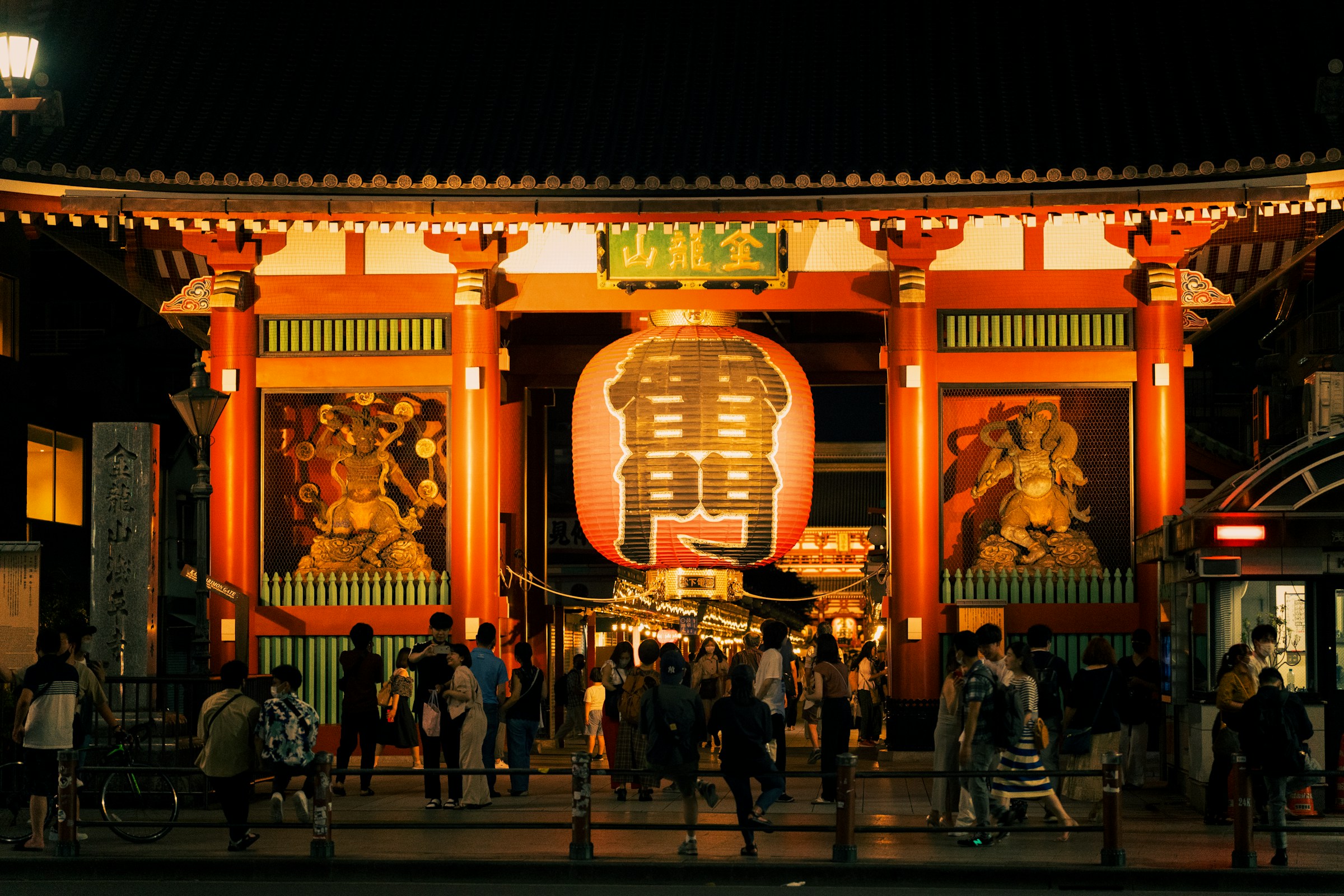
Kaminarimon is the Thunder Gate of Senso-ji, guarded by the gods of wind and thunder. It was rebuilt in 1960 after ninety five years, paid for by the founder of Panasonic.
- 3Day 0
Nakamise-dori: Rent Paid in Sweeping
Nakamise-dori, Asakusa 1-chome, Taito-ku, Taito City
Nakamise-dori runs about 250 metres from the Thunder Gate to the temple. Its stalls began in the late 1600s, paid for in sweeping, and its 1925 shop rows are older than the gates.
- 4Day 0
Hozomon and the Five-Storey Pagoda: Sandals for Demons
Hozomon Gate, Senso-ji, 2-3-1 Asakusa, Taito-ku, Taito City
Hozomon is the temple's inner gate, with giant straw sandals from Yamagata on its back. The five-storey pagoda beside it dates from 1973 and holds relics from Sri Lanka.
- 5Day 0
Senso-ji Main Hall: The Kannon Nobody Sees
Senso-ji Main Hall, 2-3-1 Asakusa, Taito-ku, Taito City
The Senso-ji Main Hall houses a Kannon statue that is never shown, even to the head priest. The hall burned in 1945; the statue survived, buried in a bronze basin.
- 6Day 0
Asakusa Shrine and Nitenmon: The Survivors of 1649
Asakusa Shrine, 2-3-1 Asakusa, Taito-ku, Taito City
Asakusa Shrine honours the fishermen and headman of the founding story. Its 1649 hall and the Nitenmon gate beside it both survived the 1945 air raid.
- 7Day 0
Hanayashiki and Okuyama: Edo's Pleasure Ground Behind the Temple
Asakusa Hanayashiki, 2-28-1 Asakusa, Taito-ku, Taito City
Hanayashiki began in 1853 as a flower garden on land from the temple. It stands beside Okuyama, the back of the temple grounds and Edo's great pleasure ground of teahouses, acrobats and sideshows.
- 8Day 0
Rokku: The Sixth District, Where the Show Moved
Asakusa Engei Hall, 1-43-12 Asakusa, Taito-ku, Taito City
Rokku is the sixth district of Meiji's Asakusa Park, laid out for the shows. It gave Japan its first permanent cinema, stood in the shadow of the Twelve Storeys tower, and its rakugo hall plays every day.
- 9Day 0
Chingodo: The Tanuki Who Guard Against Fire
Chingodo, Denboin-dori, Asakusa, Taito-ku, Taito City
Chingodo is Senso-ji's small shrine to the tanuki, who by legend guard the abbot's residence against fire. Performers pray here too, and it came through both 1923 and 1945.
Meeting point
Azumabashi and the Sumida River, Tokyo Azumabashi Bridge, Asakusa end, Kaminarimon 2-chome, Taito-ku, Tokyo, JP
Pick up
Pickup is not provided.
Cancellation policy · Tokyo Asakusa and Senso-ji | Self-Guided Audio Walking Tour
Standard Viator policy
- Cancellation 0–24 hours before departure: 100% cancellation fee.
- Cancellation 24–24000 hours before departure: 0% cancellation fee.
Good to know
Operated by Roamer and sold by AGORA. Your voucher and booking reference arrive by email straight after payment.